-
Title
-
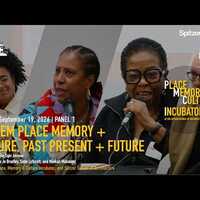
Panel 1: Harlem Place Memory + Culture, Past Present + Future
-
Description
-
As part of Reimagining the Archive: Black Memory as Design Praxis, this panel brings together leaders in historic preservation, Black arts and culture, and African American history to explore the relationships between collective memory, cultural institutions, and the built environment.
Featuring Valerie Jo Bradley, co-founder and president of Save Harlem Now!; Sade Lythcott, CEO of the National Black Theatre; and Minkah Makalani, Associate Professor of History and Africana Studies at Johns Hopkins University, the conversation examines how community advocacy, cultural production, and historical scholarship contribute to preserving and reimagining Black spaces and histories.
Moderated by Najha Zigbi-Johnson, writer, educator, and cultural organizer, the discussion engages questions of Black space-making, historic preservation, cultural memory, and the ongoing role of community-led initiatives in shaping Harlem and beyond.
This recording offers an opportunity to revisit the conversations and perspectives shared during the symposium, exploring how archives, cultural institutions, and community activism can sustain Black histories and inform future possibilities for the built environment.
About the Symposium
Reimagining the Archive: Black Memory as Design Praxis was presented by the Place, Memory & Culture Incubator (PMCI) and the Bernard and Anne Spitzer School of Architecture at the City College of New York, in collaboration with the Harlem Place, Memory & Culture Archive (PMCA).
-
Type
-
MovingImage
-
Creator
-
Maldonado, Alfredo
-
Bradley, Valerie Jo
-
Lythcott, Sade
-
Makalani, Minkah
-
Zigbi-Johnson, Najha
-
Date
-
2026-09-19
-
Language
-
English
-
Subject
-
Valerie Jo Bradley
-
Sade Lythcott
-
Minkah Makalani
-
Najha Zigbi-Johnson
-
Black Memory as Design Praxis
-
Abstract
-
In this panel, Valerie Jo Bradley, Sade Lythcott, Minkah Makalani, and Najha Zigbi-Johnson reflect on Harlem's place, memory, and culture by exploring how Black spatial history and grassroots archiving serve as vital design tools for shaping the community's future.