Reimagining the Archive: Black Memory as Design Praxis Symposium
- Title
- Reimagining the Archive: Black Memory as Design Praxis Symposium
- Description
- Reimagining the Archive: Black Memory as Design Praxis was presented by the Place, Memory & Culture Incubator (PMCI) and the Bernard and Anne Spitzer School of Architecture at the City College of New York, in collaboration with the Harlem Place, Memory & Culture Archive (PMCA).
Items
View as:
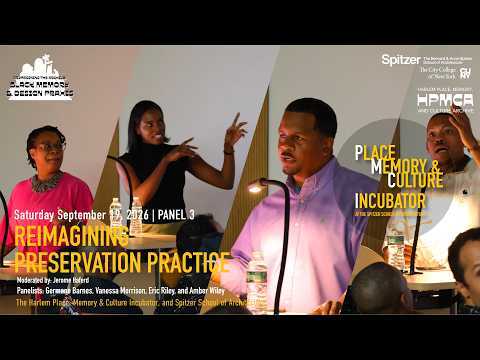
Panel 3: Reimagining Preservation Practice
The Place, Memory & Culture Incubator (PMCI) at the Spitzer School of Architecture proudly presents Reimagining the Archive: Black Memory as Design Praxis, a three-day symposium exploring how Afro-diasporic memory and cultural practices are reshaping architecture, preservation, and the built environment.
How can preservation practices move beyond protecting buildings to center the people, cultures, and community histories that give places meaning?
This panel brings together architects, urban planners, educators, and community design practitioners to explore new approaches to historic preservation, equitable planning, and community-led design. Through their work across architecture, research, policy, and public engagement, the panelists consider how preservation can support cultural continuity, address inequities, and create more inclusive built environments.
Featuring Germane Barnes, Director of Studio Barnes; Vanessa Morrison, Co-Founder and CEO of Open Design Collective; Eric Riley, Planning Principal at KDI's Los Angeles office; and Amber Wiley, Wick Cary Director of the Institute for Quality Communities and Associate Professor at the University of Oklahoma, the discussion examines how design research, community engagement, and collaborative planning can reshape preservation practice.
As part of Reimagining the Archive: Black Memory & Design Praxis, this conversation considers how communities can preserve their histories, strengthen their connections to place, and influence the future of the built environment.
Presented by the Place, Memory & Culture Incubator (PMCI) and the Bernard and Anne Spitzer School of Architecture at the City College of New York, in collaboration with the Harlem Place, Memory & Culture Archive (PMCA).
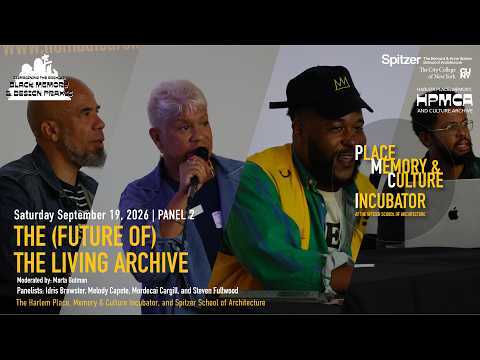
Panel 2: The Future of the Place-Based Living Archive
The Place, Memory & Culture Incubator (PMCI) at the Spitzer School of Architecture proudly presents Reimagining the Archive: Black Memory as Design Praxis, a three-day symposium exploring how Afro-diasporic memory and cultural practices are reshaping architecture, preservation, and the built environment.
How can archives remain living, community-centered spaces that preserve collective memory while shaping the future of place?
This panel brings together artists, archivists, cultural leaders, and creative practitioners to explore the evolving possibilities of place-based archives and community-led approaches to preserving Black histories and cultural heritage.
Featuring Idris Brewster, Executive Director of Kinfolk Foundation; Melody Capote, Executive Director of the Caribbean Cultural Center African Diaspora Institute (CCCADI); Mordecai Cargill, Co-Founder and Creative Director of ThirdSpace Action Lab; and Steven Fullwood, archivist, writer, and Co-Director of the Nomadic Archivists Project, the conversation examines how augmented reality, multimedia mapping, institutional archiving, and collaborative collecting can expand how communities document, experience, and share their histories.
Moderated by Marta Gutman, Dean, PI & Program Co-Director.
Part of Reimagining the Archive: Black Memory & Design Praxis, presented by the Place, Memory & Culture Incubator (PMCI) and the Bernard and Anne Spitzer School of Architecture at the City College of New York, in collaboration with the Harlem Place, Memory & Culture Archive (PMCA).
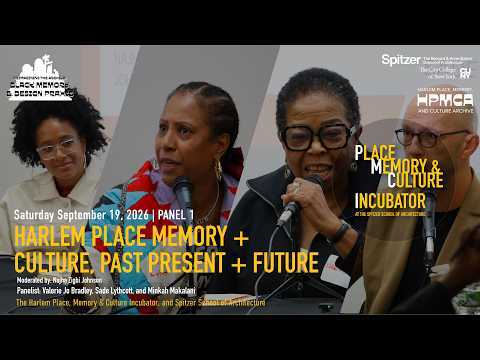
Panel 1: Harlem Place Memory + Culture, Past Present + Future
As part of Reimagining the Archive: Black Memory as Design Praxis, this panel brings together leaders in historic preservation, Black arts and culture, and African American history to explore the relationships between collective memory, cultural institutions, and the built environment.
Featuring Valerie Jo Bradley, co-founder and president of Save Harlem Now!; Sade Lythcott, CEO of the National Black Theatre; and Minkah Makalani, Associate Professor of History and Africana Studies at Johns Hopkins University, the conversation examines how community advocacy, cultural production, and historical scholarship contribute to preserving and reimagining Black spaces and histories.
Moderated by Najha Zigbi-Johnson, writer, educator, and cultural organizer, the discussion engages questions of Black space-making, historic preservation, cultural memory, and the ongoing role of community-led initiatives in shaping Harlem and beyond.
This recording offers an opportunity to revisit the conversations and perspectives shared during the symposium, exploring how archives, cultural institutions, and community activism can sustain Black histories and inform future possibilities for the built environment.
About the Symposium
Reimagining the Archive: Black Memory as Design Praxis was presented by the Place, Memory & Culture Incubator (PMCI) and the Bernard and Anne Spitzer School of Architecture at the City College of New York, in collaboration with the Harlem Place, Memory & Culture Archive (PMCA).
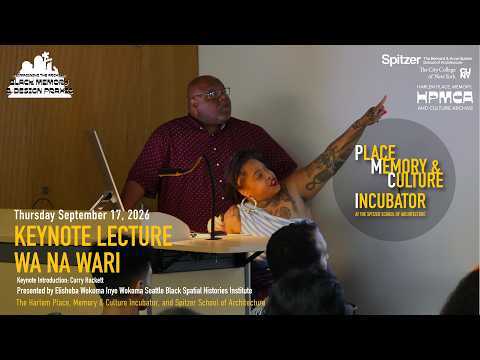
Keynote Lecture: Elisheba Wokoma and Inye Wokoma, co-founders of Wa Na Wari
The Place, Memory & Culture Incubator (PMCI) at the Spitzer School of Architecture proudly presents Reimagining the Archive: Black Memory as Design Praxis, a three-day symposium exploring how Afro-diasporic memory and cultural practices are reshaping architecture, preservation, and the built environment.
This keynote features Elisheba Wokoma and Inye Wokoma, co-founders of Wa Na Wari, and an introduction and Q&A led by Curry Hackett. The speakers discuss their pioneering work in establishing a cultural hub in Seattle's Central District, demonstrating how grassroots cultural stewardship can actively counter displacement and honor Black heritage.
Wa Na Wari creates space for Black ownership, possibility, & belonging through art, historic preservation, & connection. Sited in a fifth-generation, Black-owned home, Wa Na Wari is an immersive community art project that reclaims Black cultural space and makes a statement about the importance of Black land ownership in gentrified communities through art, historic preservation, and connection. In 2025, Wa Na Wari commissioned “Gilded Porch” installation by former PMCI faculty Curry Hackett, which will be on view.
Elisheba Wokoma’s vision for cultural placemaking drives Wa Na Wari’s growth as a cultural institution. She served as public art manager for the city’s Office of Arts and Culture and founded and operated Faire Gallery and Café before becoming Wa Na Wari’s curator. Elisheba is a conceptual artist heavily influenced by the Fluxus movement. She sees art “taking the role of philosophy in the 21st century” and providing “the frame for discussing and solving our complex and important civic problems.”
Inye Wokoma has been the Guardian of Estate for his grandmother, Goldyne Green, since 2016. He is instrumental in coordinating a site control vision between Wa Na Wari and the Green family, and work with Black homeowners. As a journalist, filmmaker and visual artist, he explores themes of identity, community, history, land, politics and power. His recent projects represent prismatic explorations of the history, current experience, and future of Seattle’s African American Community.
Curry J. Hackett is a transdisciplinary designer, visual artist, and educator exploring Black relationships to land, media, and memory. A Farmville, Virginia native, his work works across scales and mediums to speculate on the aesthetics and ecologies of the American South. Hackett’s work and ideas have been featured widely.
About the Symposium
Reimagining the Archive: Black Memory as Design Praxis was presented by the Place, Memory & Culture Incubator (PMCI) and the Bernard and Anne Spitzer School of Architecture at the City College of New York, in collaboration with the Harlem Place, Memory & Culture Archive (PMCA).